The Mythic Blueprint Behind Today’s Disclosure Movement

From archangels to starfleets, the seven-figure pattern that never left human imagination.

Estimated reading time: 10 minutes

For decades, the modern idea of extraterrestrial “disclosure” has been framed as a technological problem. Could governments reveal what they know? Are unknown craft real? Is contact already underway? But long before radar, rockets, and satellites, humanity had already rehearsed something far deeper than technology – a psychological training in how to live under non-human authority itself.

It didn’t begin with aliens.
It began with angels.

At the center of that early rehearsal stands a quiet but powerful image from the Book of Revelation, written around the end of the first century CE: “the seven spirits who stand before the throne.”
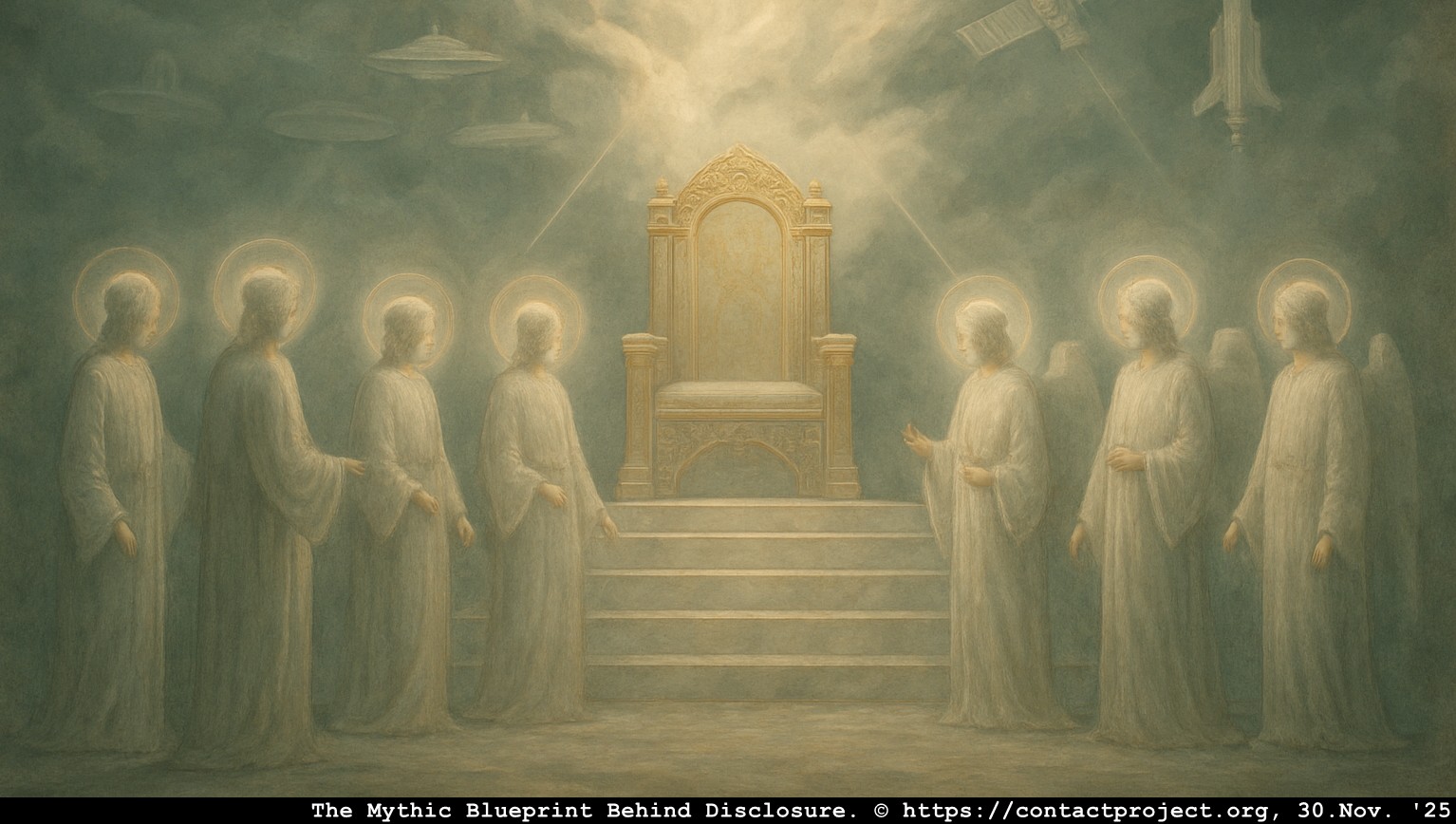
Revelation 1:4-7

Long before starships entered pop culture, this image placed structured, hierarchical non-human intelligence at the center of Western imagination. Not chaos. Not monsters. A command system.

In today’s language, that sounds less like theology – and more like governance. What we now call “disclosure” may be less a sudden revelation than the latest chapter in a very ancient psychological script.


Before Angels, There Was Only Terror (2600–1800 BCE)
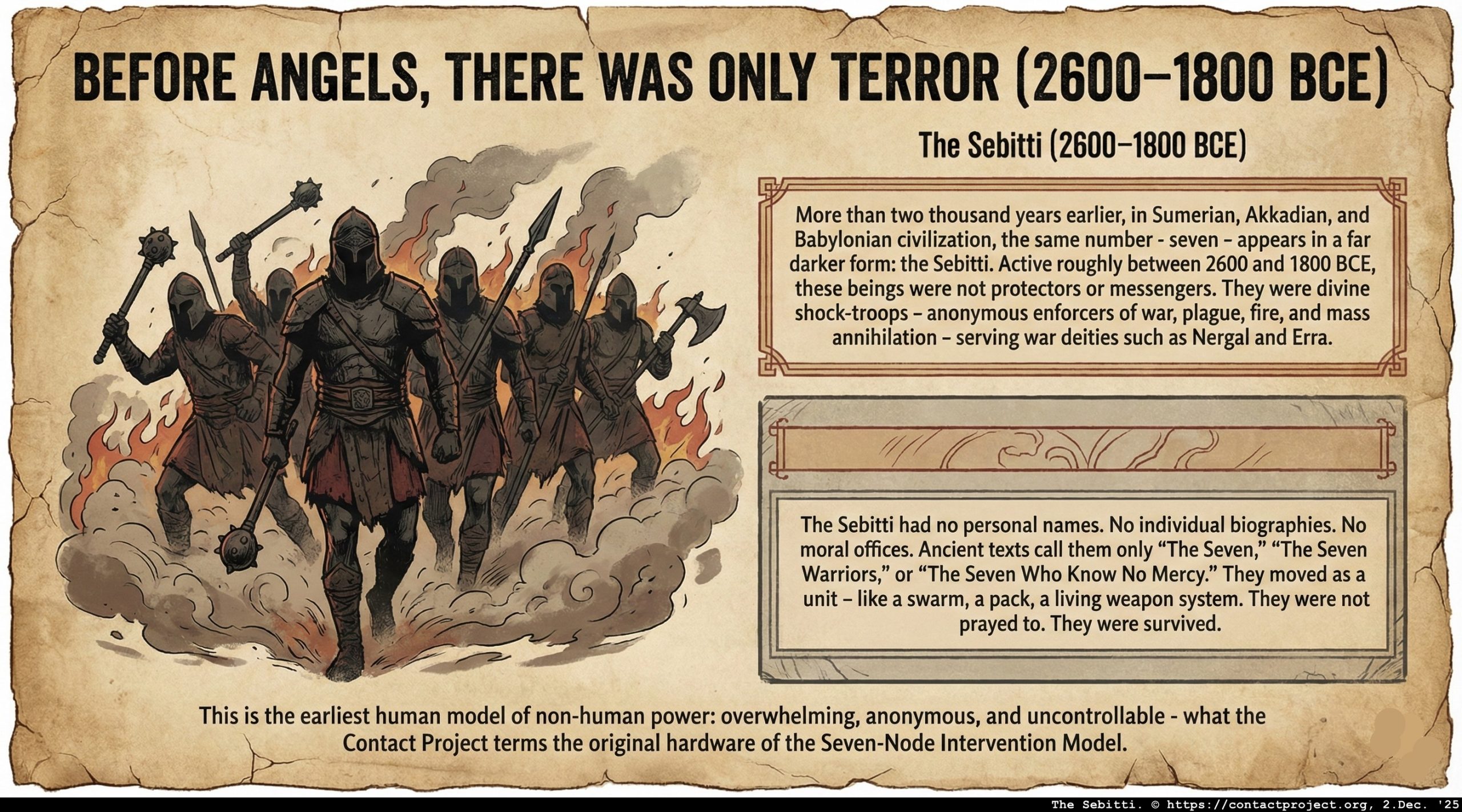
The angelic story didn’t appear out of nowhere. More than two thousand years earlier, in Sumerian, Akkadian, and Babylonian civilization, the same number – seven – appears in a far darker form: the Sebitti. Active roughly between 2600 and 1800 BCE, these beings were not protectors or messengers.

They were divine shock-troops – anonymous enforcers of war, plague, fire, and mass annihilation – serving war deities such as Nergal and Erra.

The Sebitti had no personal names. No individual biographies. No moral offices. Ancient texts call them only “The Seven,” “The Seven Warriors,” or “The Seven Who Know No Mercy.” They moved as a unit – like a swarm, a pack, a living weapon system.

They were not prayed to.
They were survived.

This is the earliest human model of non-human power: overwhelming, anonymous, and uncontrollable – what the Contact Project terms the original hardware of the Seven-Node Intervention Model.


When the Seven Became the Stars

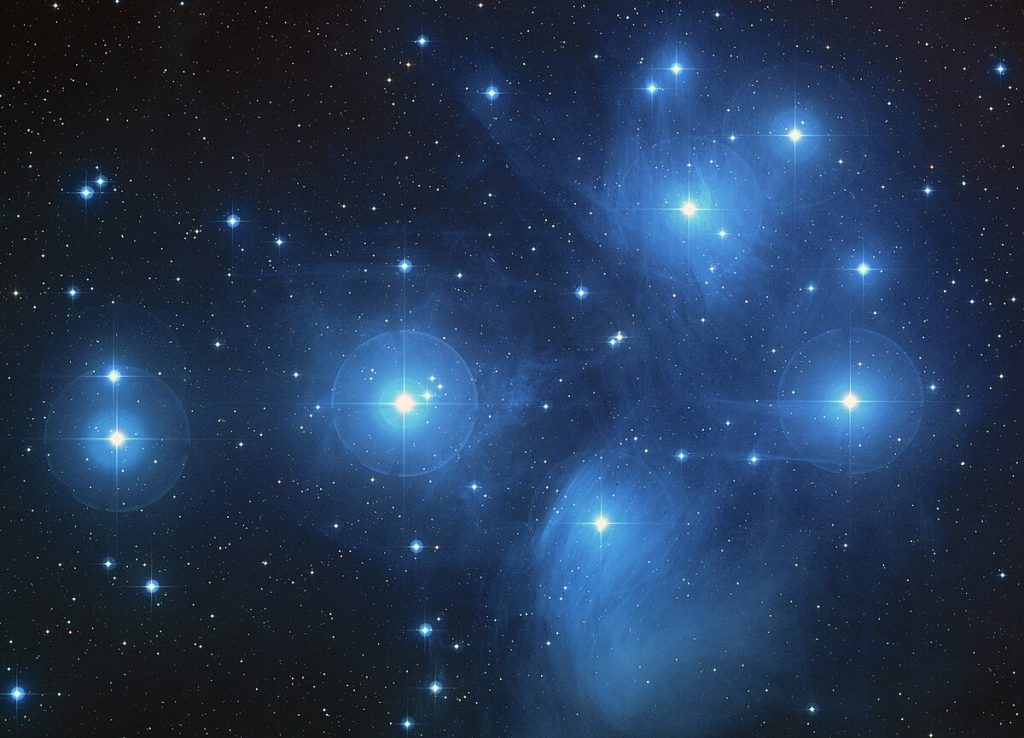
Between the terror of the Sebitti and the order of the Archangels, something extraordinary happens in ancient Greece. The same pattern of seven is lifted from destruction and projected into the night sky as the Pleiades – forever visible as the Seven Sisters.
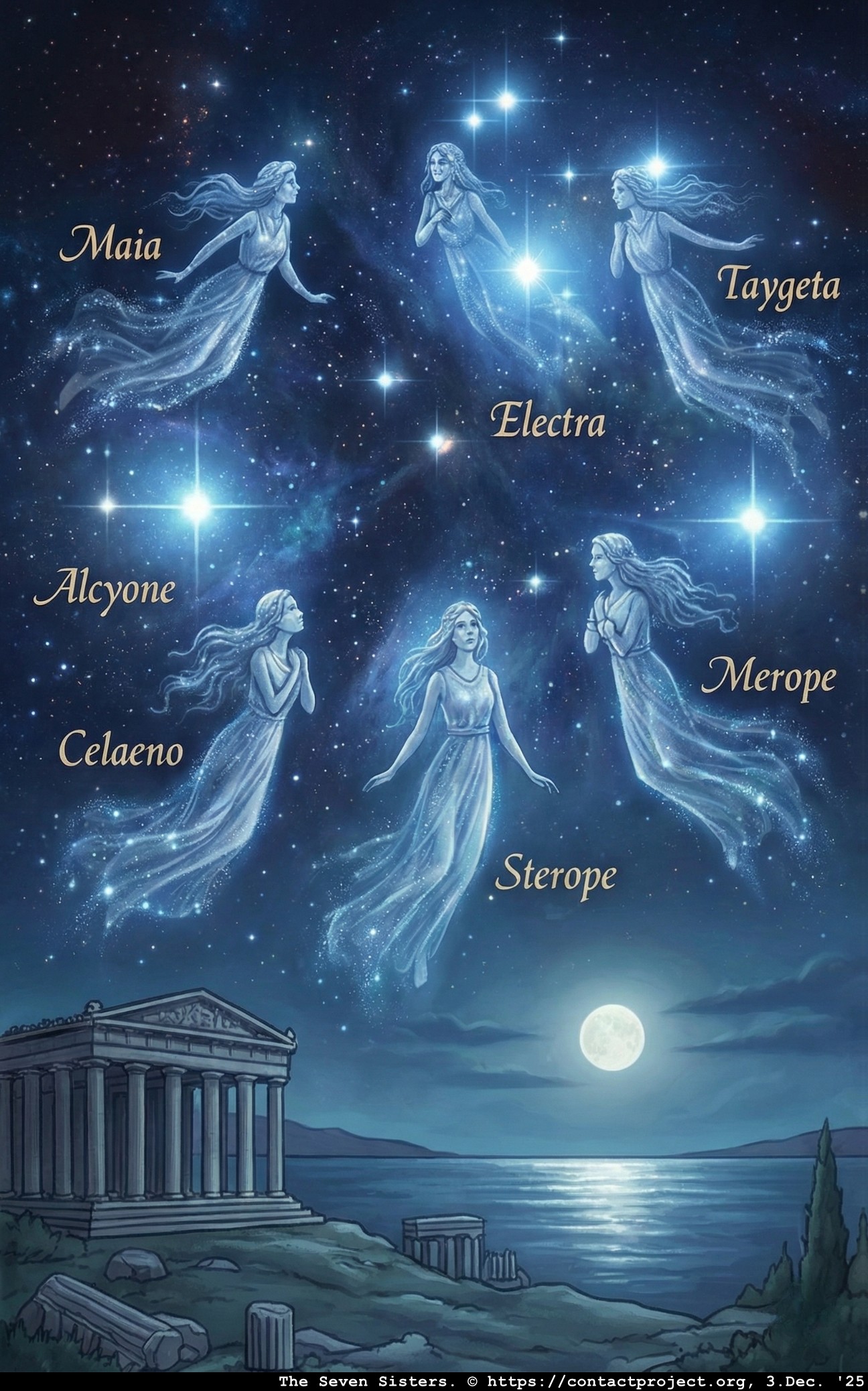
For the first time, the Seven are no longer anonymous.

They become daughters of Atlas and the sea-nymph Pleione, each receiving identity, personality, and story. Maia becomes the nurturing mother of Hermes and a symbol of spring renewal. Electra becomes tied to royal bloodlines and the fate of Troy. Taygeta retreats into wilderness under Artemis. Alcyone gives her name to the calm “halcyon days.” Celaeno carries storm and shadow. Sterope flashes with lightning and fire. And Merope, the dim sister, fades after marrying a mortal.

This is a profound psychological turning point. The Seven transform from impersonal terror into named celestial individuals. Power is no longer only something that destroys. It becomes something that can be recognized, remembered, and even loved.

The stars become the bridge.
Only after the Seven are allowed to have faces can angels exist at all.


The Critical Shift: When Power Became Law (300 BCE–100 CE)

Everything changes with the rise of the Seven Archangels during the Second Temple period and early Christianity, roughly 300 BCE to 100 CE. For the first time in history, humanity does something unprecedented with cosmic power: it names it, limits it, and distributes it into offices.

The Seven stabilize as familiar figures (Western tradition):
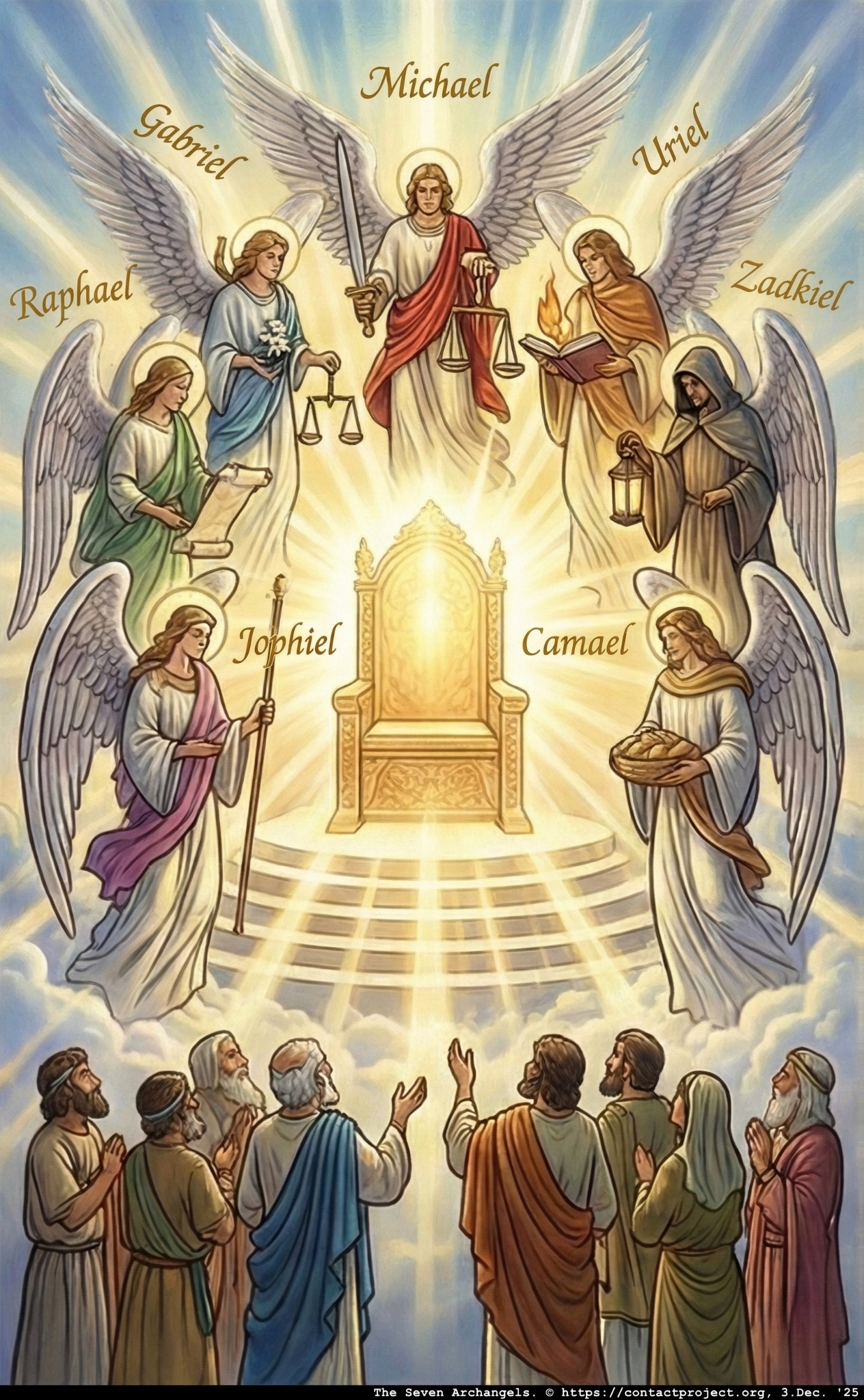
Michael as supreme commander.
Gabriel as the messenger of contact.
Raphael as healer and restorer.
Uriel as fire and purification.
Jophiel as guide through death.
Camael as judge.
Zadkiel as protector.

Power is no longer a faceless storm in the heavens. It becomes legible, regulated, and morally accountable. The Seven are no longer weapons. They are administrators.

In modern political language, this is the first successful model of distributed non-human governance. Chaos becomes order. Destruction becomes judgment, healing, and protection. Many gods collapse into one sovereign authority – but the Seven offices remain.

Same operating system.
New moral firmware.


The First Disclosure Filter


A “disclosure filter” is:

A psychological structure that allows humans to encounter overwhelming non-human power without collapsing into panic, psychosis, or blind worship.
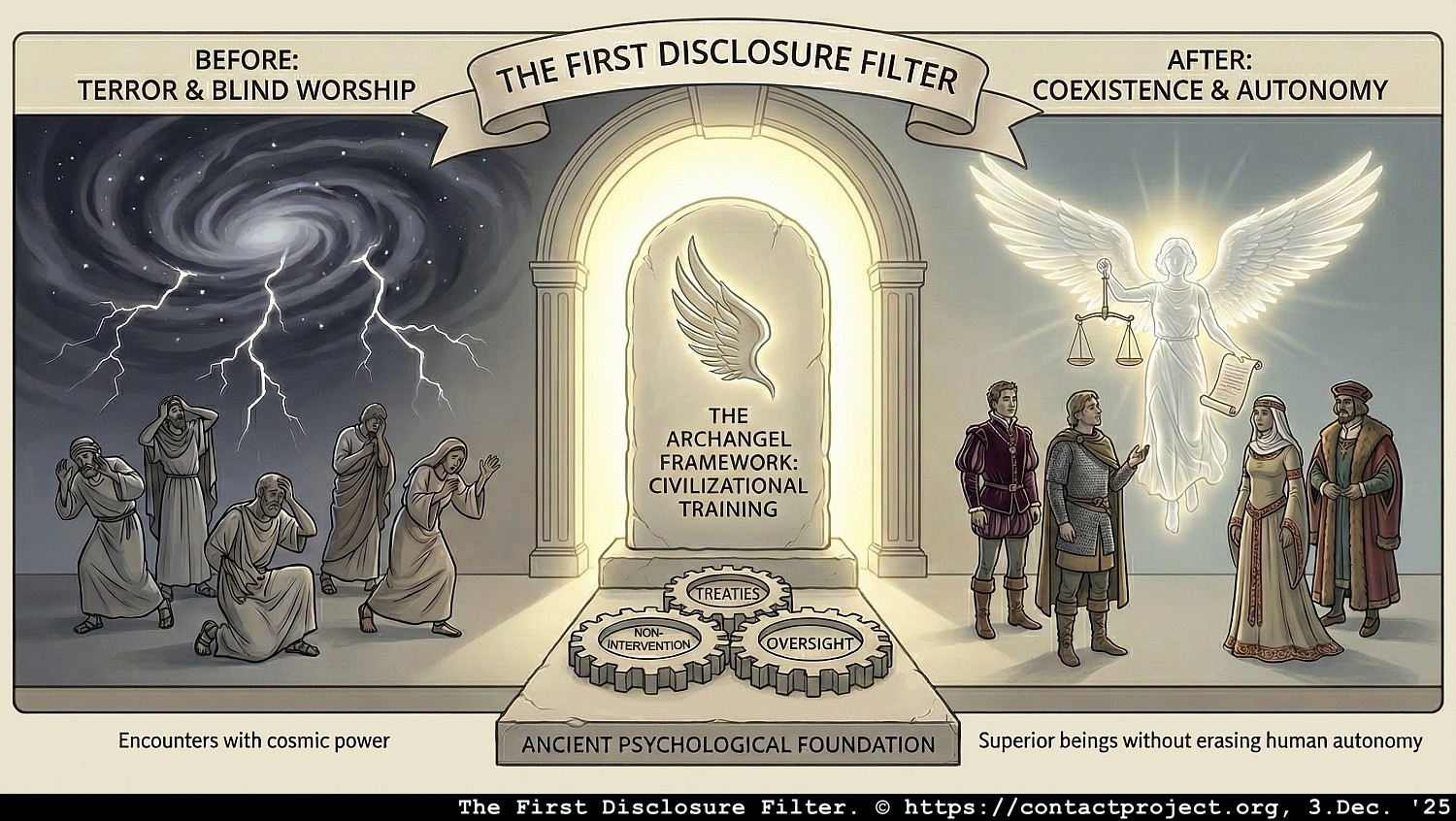
It’s not a physical device — it’s a cultural and cognitive buffer.

From a psychological standpoint, the Archangels achieved something astonishing. They taught humanity how to coexist with superior non-human authority without losing its mind.

Before them, encounters with cosmic power produced only terror or blind worship. After them, a new idea takes hold: power can exist without tyranny; judgment can occur without annihilation; non-human intelligence can be restrained by law.

Today, many worry that undeniable proof of advanced non-human intelligence might destabilize civilization. But this civilizational training began two thousand years ago. The Archangel framework quietly embedded the idea that superior beings could exist without erasing human autonomy.

Every modern discussion of treaties, oversight, and non-intervention rests on that ancient psychological foundation.


When Angels Became Human (1954–1960)

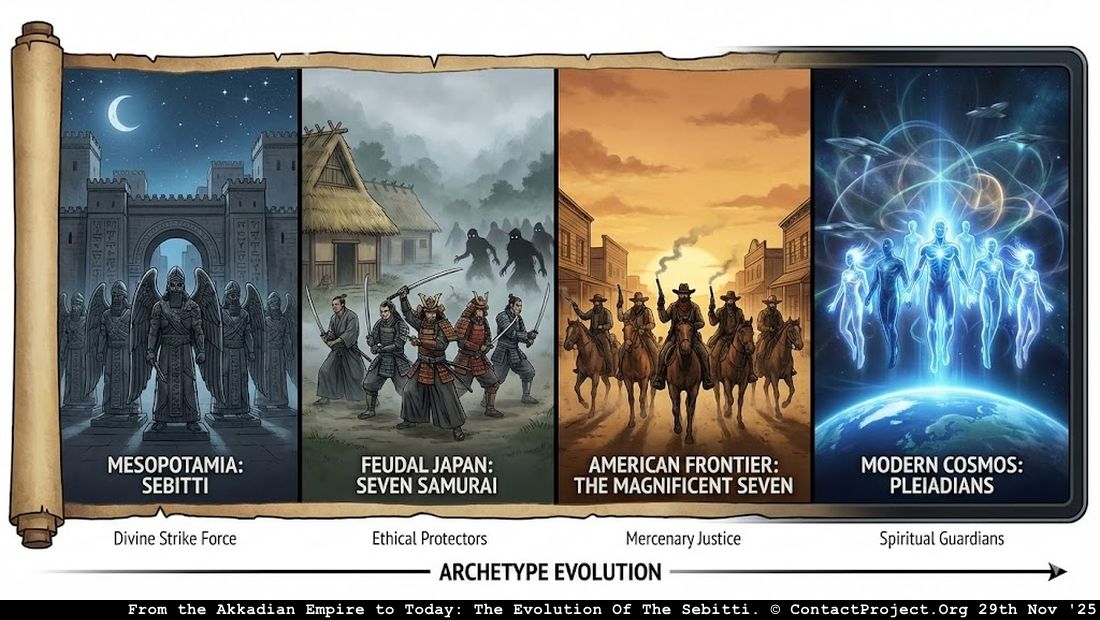
Once the Archangel model stabilized cosmic authority, the pattern did not remain in heaven. It descended into human storytelling. The Seven reappeared as mortals in Seven Samurai and soon after as frontier gunmen in The Magnificent Seven.
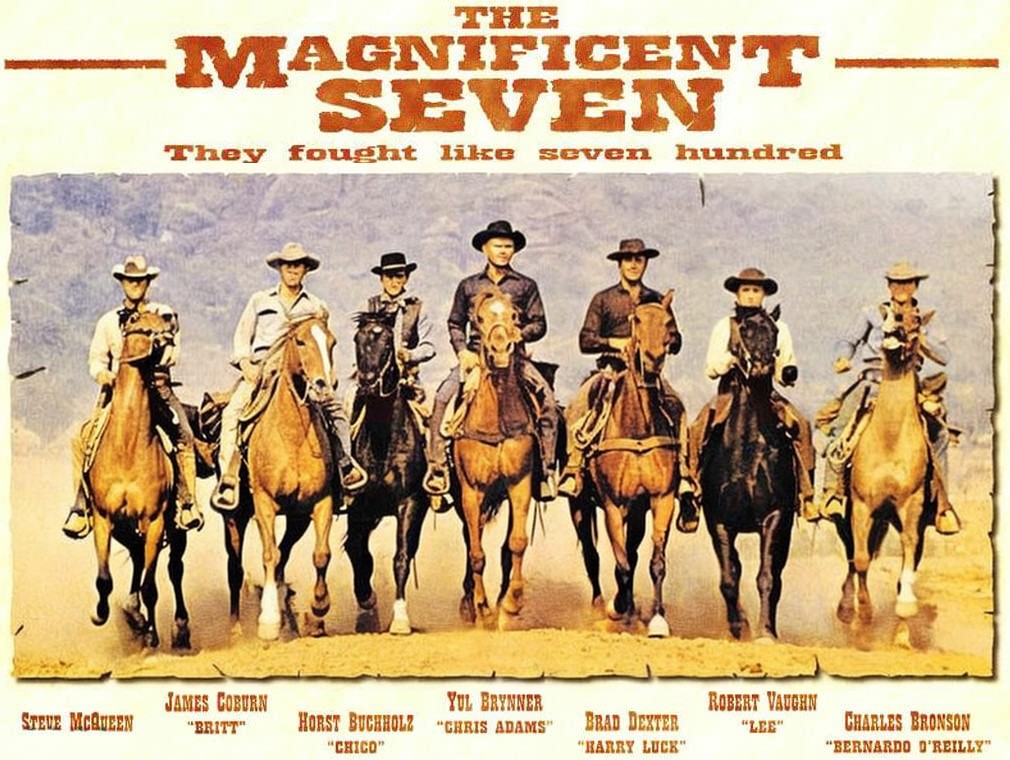
Here, divine offices become human roles. Command becomes leadership under fire. Healing becomes battlefield medicine. Judgment becomes moral law. Protection becomes sacrifice. The warriors can fail. They can doubt. They can die.

The Seven stop being supernatural and become ethical.

This matters. It trains societies to accept that guardians do not need to be gods. They can be people.


Why Angels Reappear as Starfleet Commanders

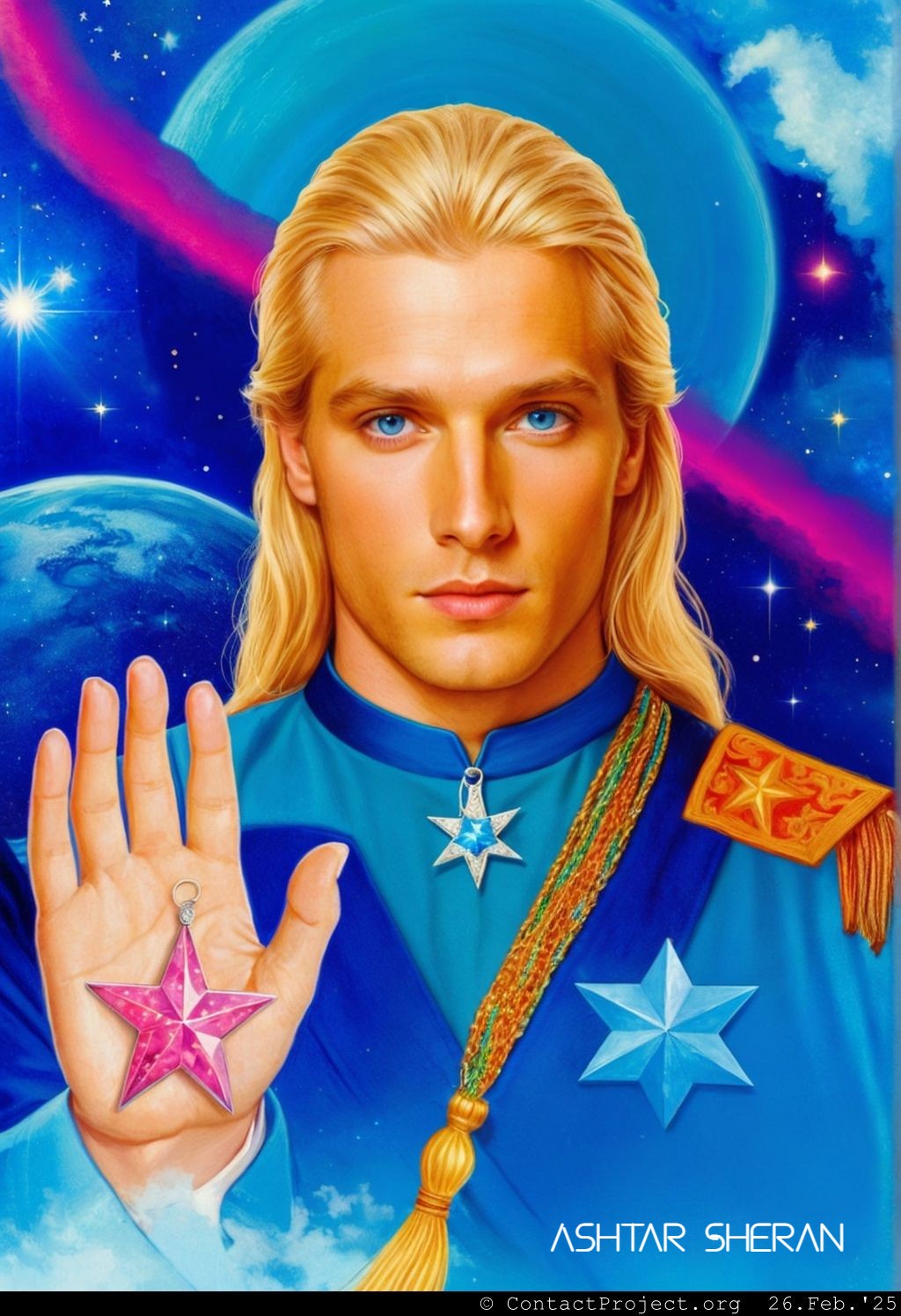
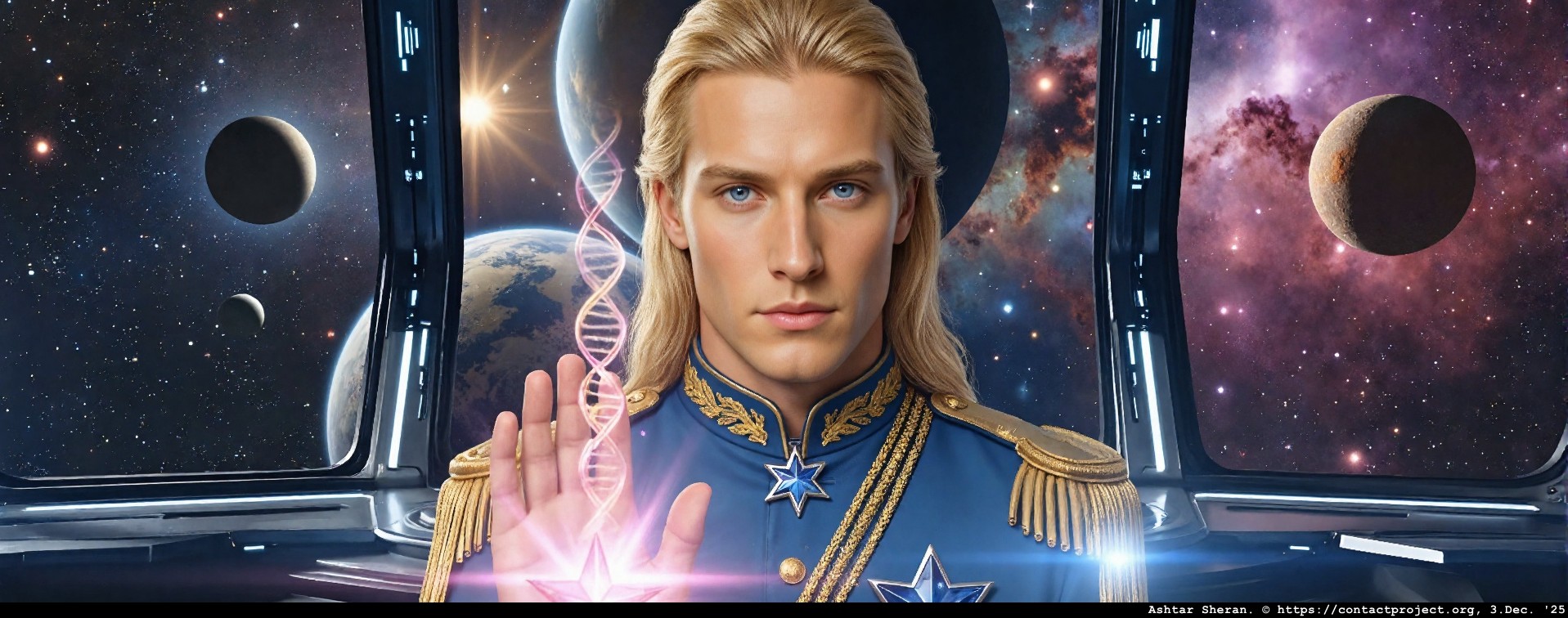
In modern contact narratives, the Seven make one final transformation. They return to the sky not as divine beings, but as technological administrators – members of what is often called a Galactic Federation. The most famous of these figures is Ashtar, described as a calm, uniformed fleet commander overseeing planetary safety.
To skeptics, this looks like recycled science fiction. To myth analysts, it is something far older wearing a new uniform.

Michael once commanded the armies of heaven.
Ashtar now commands fleets of spacecraft.

Armor becomes uniform.
Chariots become starships.
Divine law becomes protocol.

This is not the disappearance of the sacred. It is the mechanization of sacred authority.


Why the Pleiadians, the Seven, and the “Galactic Federation” Became Linked

The link between the Seven, the Pleiades, and the modern idea of a Galactic Federation does not come from ancient astronomy or mainstream theology. It comes from 20th-century New Age contact movements, which deliberately fused biblical imagery, Greek star mythology, and science-fiction governance into a single narrative system.

The logic runs like this:

1. The Pleiades are the most famous group of seven visible stars in Earth’s sky. For thousands of years, cultures around the world – from Greece to Mesopotamia to Mesoamerica – treated them as a cosmic “sisterhood” or council.

2. When 20th-century contact movements began searching for a plausible home base for benevolent extraterrestrials, the Seven Sisters provided a ready-made symbolic address in the heavens.
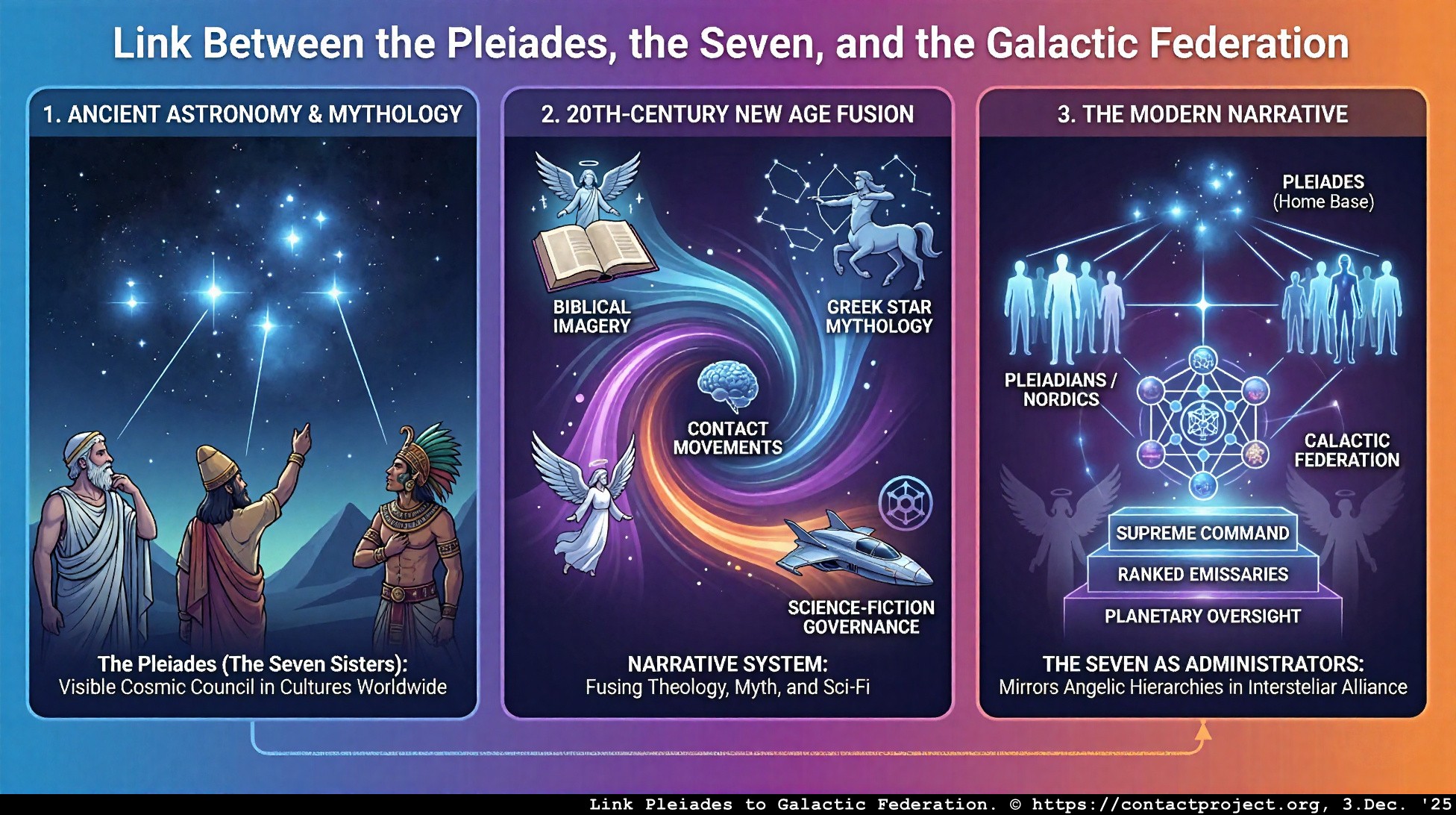
3. By the 1950s and 1960s, early UFO contact literature began to describe advanced, human-like beings called “Pleiadians” or “Nordics,” said to originate from the Pleiades and to operate as part of a larger interstellar alliance often labeled the Galactic Federation. This structure closely mirrors earlier angelic hierarchies: a supreme command authority, ranked emissaries, and planetary oversight.

In this framework, the ancient Seven are no longer spirits or stars. They become administrators.


Where Ashtar Sheran Fits Into This System

The most famous commander within this New Age Federation mythology is Ashtar Sheran, a figure who emerged from 1950s–70s channeling movements.
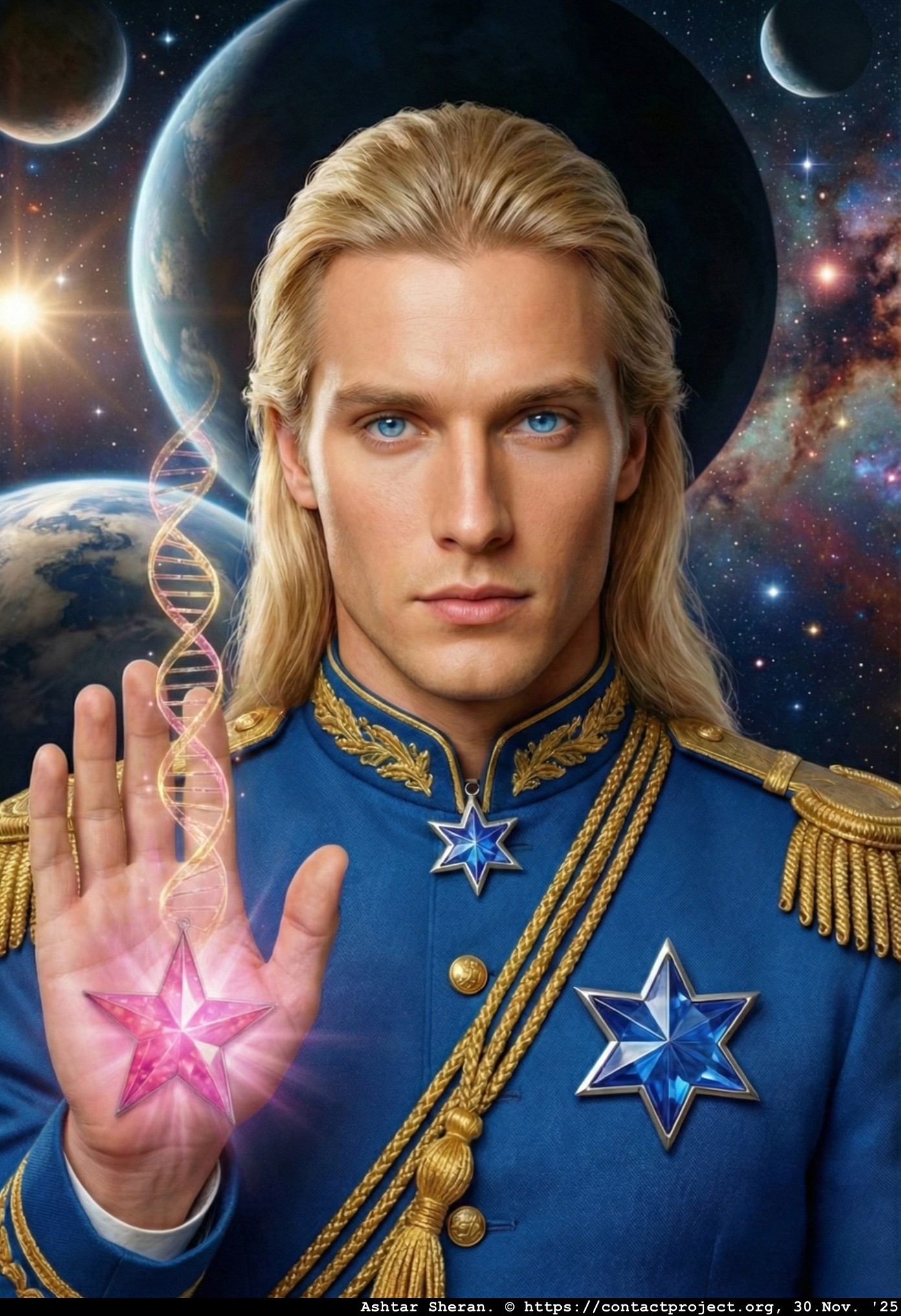
Ashtar Sheran

Ashtar is consistently described in the same terms across decades of contact literature:

• He commands vast interstellar fleets
• He issues planetary warnings and protective mandates
• He operates under laws of non-interference
• He presents himself as morally authoritative, not tyrannical

From a myth-structure perspective, this is not accidental. Ashtar functions as a direct technological re-skin of the Archangel Michael archetype:

Michael commanded the armies of heaven.
Ashtar commands fleets of spacecraft.

Armor became uniform.
Trumpets became communication arrays.
Heaven became interstellar space.

This is why modern “Federation” narratives feel so familiar even when they claim to be futuristic: they are built on ancient command imagery that already existed in religious memory.


Why the “Seven” Keep Reappearing in Pleiadian Lore

Many contact groups explicitly describe:

  • Seven districts of the Federation
  • Seven command councils
  • Seven planetary guardians
  • Or Seven origin races

Why Disclosure Is Not Really About Technology

Modern disclosure culture often assumes the core problem is technological shock – advanced craft, new physics, interstellar visitors. But history suggests the deeper challenge is not technology at all. It is authority cognition.

Can human societies accept power that is external, superior, non-human, and independent of governments and religions?

The Seven Archangels were the first successful normalization of that condition. They taught humanity that non-human authority could be moral, structured, and constrained.

Without that training layer, the idea of a Galactic Federation collapses into blind worship or mass panic. With it, the concept becomes thinkable.


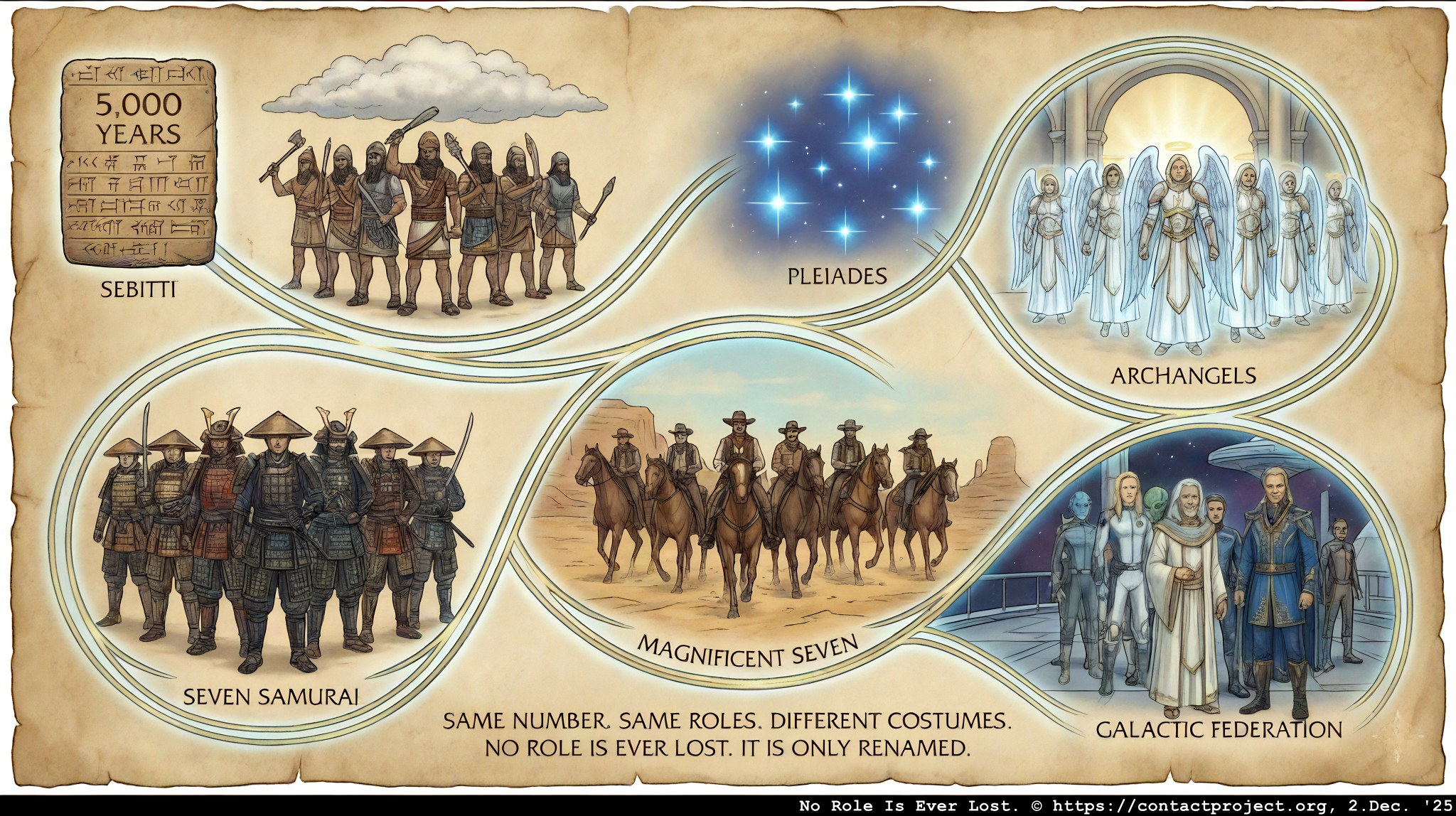
The Unbroken Transmission Line (≈ 5,000 Years)

Over five millennia, the same structure keeps resurfacing:

The Sebitti as raw destructive hardware.
The Pleiades as named cosmic individuals.
The Seven Archangels as moral governors.
The Seven Samurai as ethical humans.
The Magnificent Seven as frontier myth.
The Galactic Federation as planetary administration.
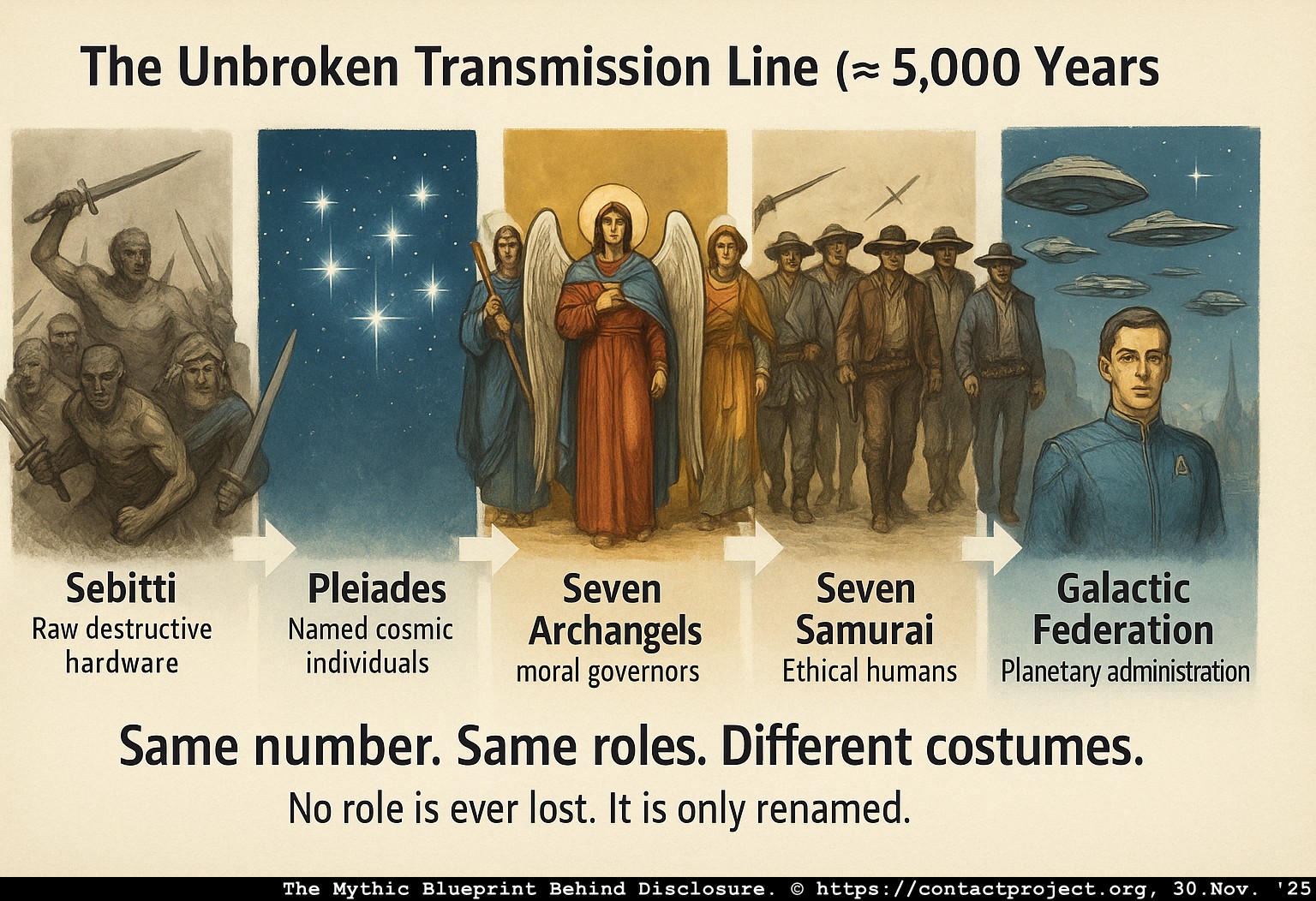
Same number.
Same roles.
Different costumes.
No role is ever lost. Only renamed.


The Modern Implication

If disclosure ever arrives in an unambiguous form, it will not be the first time humanity has faced non-human authority. It will be the latest chapter in a story that began with terror, passed through stars and angels, rehearsed itself through cinema, and now imagines itself through starships.

The real question is not whether extraterrestrial intelligence exists.

It is whether humanity fully understands the psychological training it has already been given.


Disclosure doesn’t begin with UFOs.
It begins when a civilization learns that power can be named, restrained, and trusted.
On the existence of “Pleiadians”

Estimated reading time: 11 minutes

In a hurry? Skip to “Who Are The Pleiadians?

Why the Contact Project Takes Contact Claims Seriously

The Contact Project couldn’t call itself a “Contact Project” if it ignored thousands of contactees, experiencers, and mediums who have claimed to have made contact with non-earthly beings. I don’t believe they are all eccentrics and oddballs. Human testimony – however flawed – remains one of the most persistent data streams in the long history of UFO encounters.

But testimony alone is not enough. To evaluate these claims, we must ask a deeper question: Does modern physics even allow for such encounters to be physically possible?


Future Humans and the Return to the Present

As a supporter of the extraterrestrial UFO hypothesis, I do not exclude the possibility that humans from the future may be visiting Earth in the present. This idea has been explored in depth by Michael Paul Masters, who suggests that some so-called “extratempestrials” could be our own descendants, returning through time.

If future humanity spreads outward into the galaxy – as seems statistically likely – then such visitors, if they exist, would necessarily arrive in physical spacecraft. That immediately raises the question of propulsion and spacetime mechanics.


Warp Bubbles, Faster Than Light, and a Common Misunderstanding

Recent advances in theoretical physics have shifted the discussion of faster-than-light motion from pure fantasy toward cautious plausibility. The work of Erik Lentz on plasma-based warp bubbles show that faster-than-light travel may be physically possible without requiring exotic negative energy.

However, this is where a major misunderstanding enters public discourse:

Faster-than-light travel does not automatically imply travel into the past.

Backward time effects would only arise if closed timelike curves – true causal loops in spacetime – were physically realizable. Faster-than-light motion reopens the theoretical possibility of backward time influence, but it does not guarantee it.

This point is often misunderstood.


What Physics Actually Allows: Seth Lloyd and Time Loops

The conditional link between FTL travel and time-loop behavior has been demonstrated most clearly in the field of quantum information. In his MIT lecture on closed timelike curves, Seth Lloyd shows that under specific spacetime constraints, causal loops are mathematically self-consistent.

In simple terms: physics does not forbid limited forms of backward time influence – but only under highly constrained conditions.

This distinction removes the exaggerated claim that “FTL = automatic time travel,” while still acknowledging that modern physics permits far more flexibility than classical intuition ever allowed.

Listen to Seth Lloyd, MIT, on time travel:


Superluminal Minds: Telepathy as Nonlocal Physics

Beyond physical propulsion, my work also explores whether nonlocal communication – often described as ESP or telepathy – could operate through structured superluminal information channels. This speculative framework is developed in the article series:

Superluminal Brainwaves: Imagine a World Where Particles Travel Faster Than Light in a Different Dimension.

At the technical core of this work lies the theory of Causal-Foliated Signaling (CFS). CFS proposes that spacetime may contain a subtle internal layering of time, allowing certain near-field or evanescent quantum effects to share phase information slightly outside the classical light cone, yet without violating global causality.

In this view, time behaves like a stack of perfectly ordered pages: each page turns in sequence, even if some processes advance just a little faster within their own layer. Superluminal coherence becomes possible – but paradox-free.


The Quantum-Coupled Transistor: Testing the Impossible

CFS is not presented as metaphysics. It is designed to be experimentally testable through a proposed nanodevice: the Quantum-Coupled Transistor (QCT) – a dual-graphene tunneling structure with an h-BN gap that creates a confined nonlinear quantum medium.

Inside this tightly bounded region:

  • Standard quantum non-communication rules are slightly relaxed
  • A vanishingly small but non-zero classical signal capacity may emerge
  • Correlations could appear before any light-speed signal could arrive

This keeps physics “bent but not broken”:

  • Localization: the effect exists only inside the engineered gap
  • Smallness: the signal remains whisper-level
  • Global conservation: probability, energy, and causality remain intact

If confirmed, this would establish – for the first time – a laboratory-controlled, causally consistent superluminal signaling channel.


What Is Actually Original in This Project

Warp drives, closed timelike curves, quantum nonlocality, and even speculative telepathy all exist independently in prior science and science fiction.

What is original to this project is the specific operational synthesis, laid out in:

“Notes About Time Travel – A Practical Framework

This model integrates:

  • A navigation-based interpretation of spacetime targeting
  • Use of FTL travel as a coordinate-matching system in moving cosmic frames
  • A strict separation between:
    • Touristic traversal (self-consistent loops)
    • Timeline-branching traversal (causal divergence)
  • The Alpha–Beta universe structure for paradox resolution
  • And now, through Causal-Foliated Signaling, a mechanism for structured superluminal cognition without time paradox

To the best of my knowledge, this combined propulsion–communication–causality model has not been previously published in this exact operational form.


How the Grandfather Paradox Is Avoided

IIf a traveler uses a closed-loop FTL method and later returns to their origin timeline, history remains self-consistent despite intervention. This is the tourist trajectory.

If, instead, the traveler journeys forward through relativistic time dilation, they enter a branched causal future in which their own historical origin may no longer exist. In this case:

  • The traveler originates from Timeline Alpha
  • The altered world becomes Timeline Beta
  • The traveler remains as a foreign observer, no longer causally anchored to Beta

Paradox is resolved not by erasing the traveler – but by separating causal identity across parallel histories – a solution now reinforced by CFS’s built-in chronology protection (no-loop constraint).


What This Means for the Pleiadian Hypothesis

These models do not prove that Pleiadians exist. But they establish three powerful boundary conditions:

  • Future-human visitation is not forbidden by physics
  • Faster-than-light travel is no longer purely speculative
  • Nonlocal intelligence signaling may be possible without violating causality

This opens a third interpretive category for contact experiences:

  • Not extraterrestrials from young star systems like the Pleiades
  • Not purely hallucinatory psychology
  • But potentially misidentified future or nonlocal intelligences operating through structured superluminal cognition

With that framework in place, we can now turn to the actual Pleiadian narrative itself.


Who are the Pleiadians?

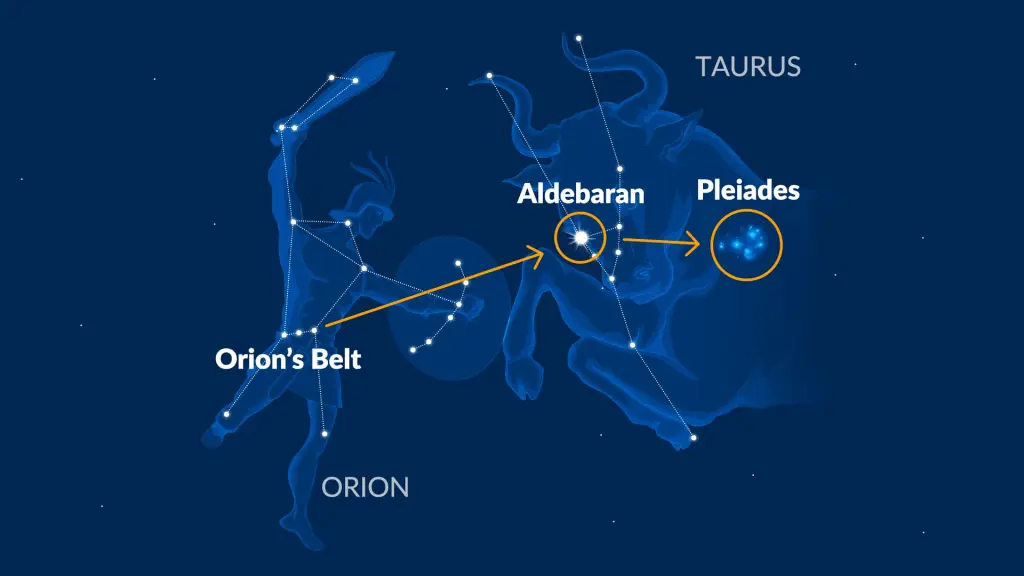
The term Pleiadians, also known as Nordic aliens, refers to humanoid beings described in UFO lore as originating from the Pleiades star cluster in the constellation Taurus.

The Pleaides star cluster is part of the constellation “Taurus”, as is Aldebaran.

According to accounts from contactees and channelers, these entities hail from the planets Erra and Temmer in the Taygeta star system. Taygeta is a double star in the constellation of Taurus. It is a member of the Pleiades open star cluster (M45). The Pleiades are also known as the “Seven Sisters.” Although their roots lie in early Sumerian myth, the “Divine Seven” became fully codified in the Akkadian Empire as the Sebitti – seven male warrior gods whose symbols and rituals were used to ward off enemies and destructive forces.

Image: The Pleiadian Ashtar Sheran refers to an extraterrestrial being or group (of most likely “seven”), that some people claim to have channeled.

The Pleiadians are often described as tall, with fair skin, blue eyes, and blond hair, resembling the Nordic or Scandinavian human races. They are a highly evolved, spiritually advanced race that aims to help humanity progress toward greater understanding and harmony. These narratives derive solely from personal testimonies of experiencers and mediums.

Ashtar, Channeling, and Failed Prophecies

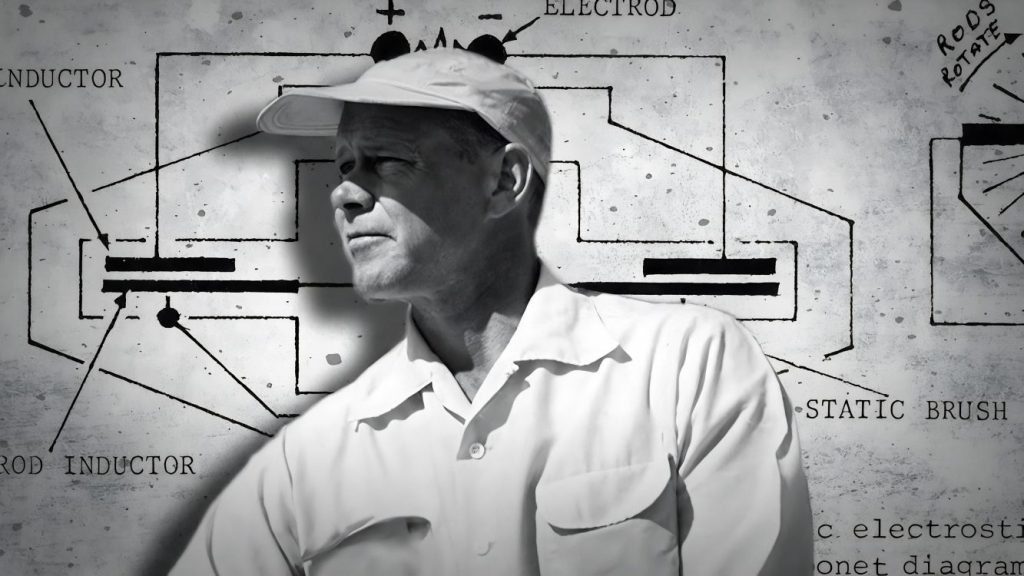
A central figure in many Pleiadian narratives is Ashtar, first introduced in 1952 by UFO contactee George Van Tassel. Later channelers claimed continued contact with the so-called “Ashtar Command.”

Yet these messages frequently contradicted one another, and repeated predictions of imminent spacecraft landings never materialized – seriously undermining the credibility of literal interpretations.


The Astronomy Problem No One Can Ignore

The Pleiades cluster lies about 440 light-years from Earth and contains roughly 1,000 stars. It is also extremely young – only 100 – 150 million years old. Taygeta itself has no confirmed exoplanets.

On Earth:

  • Simple life required hundreds of millions of years to emerge
  • Complex life required billions
  • Intelligence required nearly 4 billion years

From this alone, the evolution of indigenous humanoid life in the Pleiades is astronomically improbable.


The Human Mind and Anthropomorphic Projection

Human cognition often interprets unfamiliar phenomena through familiar frameworks.

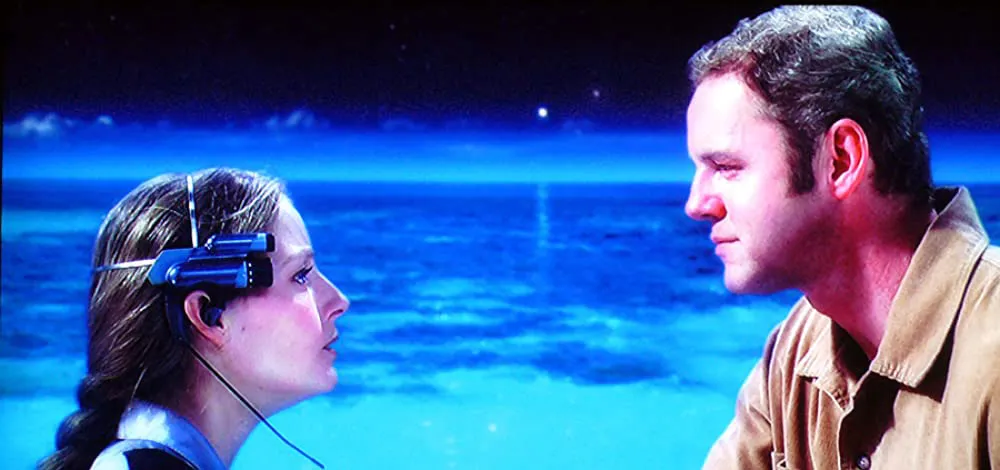
This tendency appears in Carl Sagan’s Contact. In it, aliens take the form of the protagonist’s deceased father to make an incomprehensible encounter relatable.

Similarly, descriptions of Pleiadians as Nordic humans may reflect a psychological need to frame extraordinary experiences in culturally recognizable terms. Specifically, projecting Aryan-like features onto alleged extraterrestrials. Furthermore, when someone tells of meeting or channeling “Pleiadians,” it is essentially their way of trying to understand the experience. By doing so, they provide a human frame with blond hair and Nordic features.

In summary, these descriptions may serve to bridge the gap between the extraordinary and the familiar. They help individuals make sense of their encounters.


Ancient Sky Gods and the Modern Pleiadian Revival

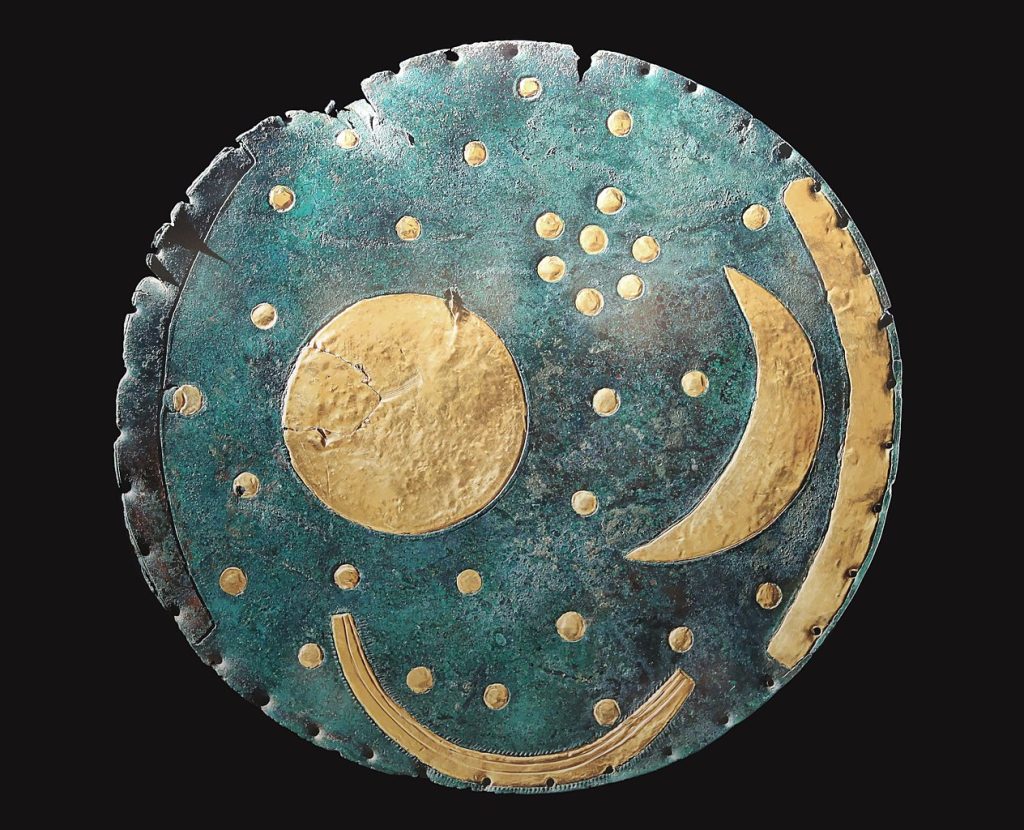
Humanity’s interest in the Pleiades spans millennia, as evidenced by artifacts like the 3,600-year-old Nebra Sky Disc, which depicts the cluster. While the Pleiades’ stars are too young to host native civilizations, some speculate that advanced beings from older regions of the galaxy might have colonized the cluster. Yet, no credible evidence supports this hypothesis.


The Magnificent Seven

Claims of Pleiadians are rooted in mythology, channeling, and UFO culture. Scientifically, the Pleiades’ age and lack of confirmed planets render the existence of indigenous humanoids implausible. While extraterrestrial settlers could theoretically inhabit the cluster, such ideas remain speculative. Ultimately, the Nordic alien narrative likely reflects humanity’s enduring desire to find familiarity and peace – in the heavens as on Earth.

Image: The author’s finger with a replica of the Phaistos Disc from the Minoan civilization on Crete from approx. 1600 BC. Several Pleiades or “Seven Sisters”-like logos or shields appear on it. The alphabet and language on the disk are unknown. 

From the second millennium BC onward, the “Sebitti” (Pleiades) were often represented as groups of seven dots. They were always of masculine character, not “sisters.” The icon on the Phaistos disk is therefore possibly a depiction of the Sebitti, as there was a lively exchange between the Mesopotamian/Akkadian civilization and Crete.

On a more fundamental level it appears that the Mesopotamian Sebitti Gods have found a modern expression. This is seen in the belief in the New Age Pleiadians, Ashtar Sheran among them.


The archetype of the Seven Warriors did not vanish with ancient Mesopotamia.

It re-emerged in modern storytelling through Akira Kurosawa’s Seven Samurai, and later in the Western remake The Magnificent Seven. In each case, the structure is identical: seven outsiders who form a temporary protective force against chaos. What once appeared as divine warriors in the sky now returns as ethical warriors on Earth – and, in the Pleiadian narrative, as guardians among the stars once more.


Fact Check

  • Distance: 444 light-years
  • Age: 100–150 million years
  • Confirmed Planets: None
  • Life Potential: Native intelligence virtually impossible
  • Ancient References: Sebitti – Nebra Disc – Phaistos Disc

Curious about the mysteries of the universe? Dive deeper into the world of UFO lore, time travel theories, and the fascinating stories surrounding extraterrestrial encounters. Explore our collection of articles and stay informed—unlock the secrets of the stars today!

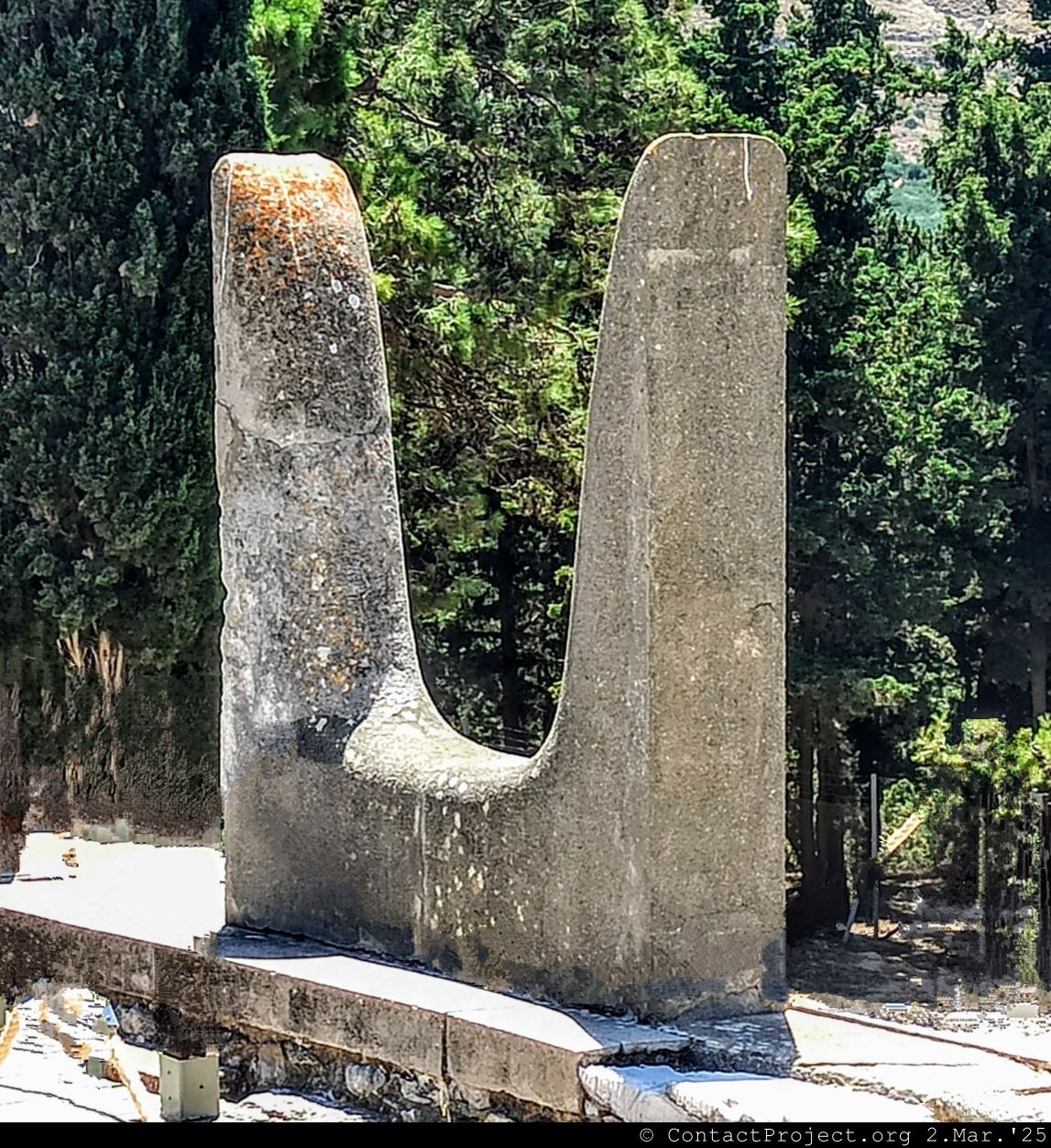
Taurus: the” “Sacred Horns” of a bull at the palace of Knossos on Crete.